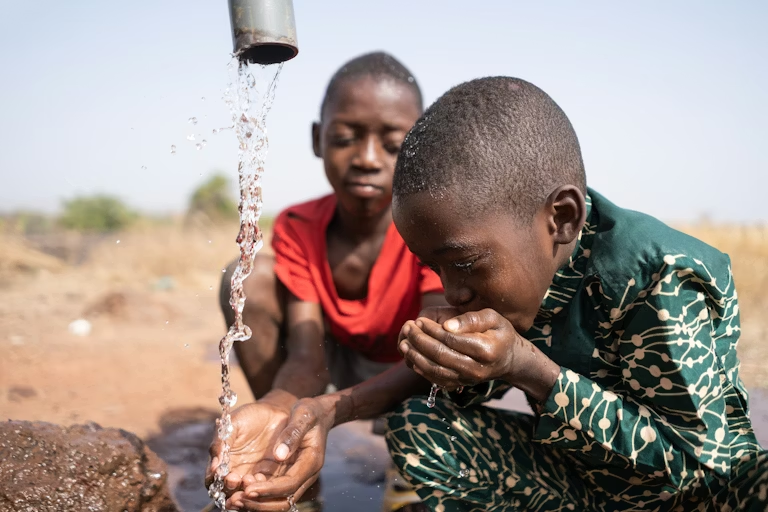
Climate change will cause more African children to die from hot weather
Earth and Leaf Editorial - African Children
African children are at the forefront of climate change disaster. They are also the very people who can do little about the crisis. The very young have little ability to thermoregulate. Surely we must do something.
Extract
Climate change has already increased global temperatures, greatly increasing extremes. This will continue unless greenhouse gas emissions are reduced to “net-zero”. The 1.5°C target of the Paris Agreement requires emissions reductions of around 50% in the next 10 years.
Newborn babies are particularly vulnerable to high temperatures. They have a limited ability to thermoregulate – or control their body temperature – and can easily become dangerously hot or cold.
Older babies and toddlers can thermoregulate better. But they are often unable to communicate their temperature discomfort. They rely on caregivers to help them adjust clothing and change their environment – like opening a window or seeking shade.
Africa has some of the poorest and hottest countries in the world. This means that young African children are at particular risk of heat stress impacts.
However, estimates of heat-related deaths in African children are limited, primarily due to the lack of available mortality data over the continent.
There has been little research into the impact of climate change on child heat-related deaths in any region of the world.
To address this knowledge gap, we estimated present day and future heat-related mortality due to climate change in African children under five years. We did this using a range of different global heating scenarios and information from a small number of existing studies relating temperatures to heat-related child deaths in Africa.
We also considered population growth and recent declines in the total child mortality rates in African countries due to developmental improvements such as better healthcare and infrastructure.
We estimated that between 2011 and 2020 there were between 12,000 and 19,000 heat-related child deaths per year in Africa.
Climate change accounts for approximately half of these deaths. The additional deaths due to climate change cancel out the recent reduction in heat-related deaths that was achieved through developmental improvements.
Our research underscores the urgent need to reduce emissions and take adaptation measures to reduce the impact of heat on babies and children.
Future deaths
The number of child deaths per year due to heat is currently small compared to the number of deaths from diseases such as malaria. Malaria causes approximately 400,000 deaths per year in African children under five.
However, the future growth in heat related deaths depends on future greenhouse gas emissions and subsequent global warming.
Even assuming declining overall child mortality and a rapid reduction in emissions, temperatures and heat deaths will continue to increase until the middle of this century. From 2040 onwards, the benefits of limiting global warming to 1.5°C are stark.
Links to Other Relevant Stories and Sites
Thank you for reading. There are many more interesting articles in the Earth and Leaf Library.
Earth and Leaf would like to acknowledge the great work done by the many journalists, scientists, photographers and contributing organisations that we showcase in our Library. We credit these contributors. We could not make a contribution to this critical work without their hard work and dedication.