Sierra Leones artisanal fishers turn to destructive practices
{Fishers turn to destructive practices – extract below}
As catches fall, Sierra Leones artisanal fishers turn to destructive practices
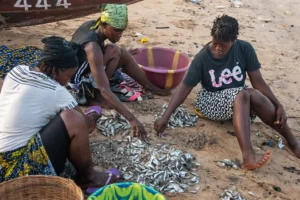
Sierra Leone’s fish stocks have been under severe strain in recent years due to intensive industrial fishing and a growing population of artisanal fishers, with fishers consistently reporting falling catches.
This has triggered heightened competition for increasingly scarce yields.
To secure their livelihoods, artisanal fishers have turned to unsustainable fishing gear, such as undersize-mesh nets, and target fish breeding and nursery grounds, disrupting the fish reproductive cycle.
PORT LOKO DISTRICT, Sierra Leone — At 5 a.m., as the horizon brightens and waves start to subside, more than a dozen wooden canoes along the shoreline between the settlements of Mahera Beach and Banda in northern Sierra Leone set off into the ocean.
Each canoe casts a net, one end tied to a pole on the beach, and traces a semicircle as it progresses into the water. Weights attached to the net fall to the ocean floor, trapping fish on the beach side.
Once the semicircle is complete, the net’s other end is dragged to shore. Two groups of four fishers then take hold of each end and begin pulling the net out of the water. After three hours of intense work, the fishers haul the net onto the beach. It contains a few crabs, shrimps and hundreds of thrashing baby fish.
Why do Fishers turn to Destructive Practices?
This fishing method, called beach seining, is banned in Sierra Leone due to its lack of selectivity and tendency to bring in excessive catches of juvenile fish, which aggregate in shallow coastal waters before reaching maturity and migrating to the open sea. Yet it’s becoming increasingly popular among local fishers.
“You just cast the net and after some time, you have fish,” said Foday Kamara, a 26-year-old owner of one of the nets on the beach. That’s why fishers turn to destructive practices.
Today’s link to our pages or posts . . .
In Sierra Leone, local fishers and foreign trawlers battle for their catch

